

Cooperative Intelligent Transportation Systems Test and Application Corridor:
The First Application for Cooperative Intelligent Transportation Systems in Türkiye
Capacity: Max 9 (per visit)
Cost: 50 Euro
Work carried out in the field of intelligent transportation systems in Türkiye has taken on a new dimension in recent years with the development of cooperative and connected transportation technologies. In this context, Cooperative Intelligent Transportation Systems (C-ITS) Test and Application Corridor, implemented by the General Directorate of Highways, is the first field example in Türkiye where C-ITS are comprehensively applied under real traffic conditions. This corridor is an important milestone in Türkiye's transition to connected vehicles and cooperative transportation infrastructure.
C-ITS are a set of systems that enable real-time data exchange between vehicles and infrastructure elements via wireless communication technologies. Within the scope of these systems, vehicle-to-vehicle (V2V), vehicle-to-infrastructure (V2I), and vehicle-to-everything (V2X) communication can be provided. Specifically, in the the C-ITS Test and Application Corridor, this communication structure aims to provide drivers with real-time, location-sensitive information about road, traffic, and environmental conditions.
As part of the “Central Software Development Project for C-ITS Project”, conducted by the General Directorate of Highways, Transportation, Maritime and Communications Research Center (UDHAM), and TÜRKSAT, the C-ITS Test and Application Corridor has been established on a route of approximately 40 km between Hasdal Junction – Istanbul Airport – Yassıören Maintenance Facility, which falls under the responsibility of the 1st (Istanbul) Regional Directorate of General Directorate of Highways. The high traffic density and diverse road geometries of the route allow for testing of C-ITS services under various scenarios.
Along the corridor, traditional intelligent transportation systems (ITS) components and C-ITS infrastructure have been integrated. Within this framework, roadside units (RSU) and in-vehicle units (OBU) produced using domestic resources have been installed. In addition, camera systems, license plate recognition systems, variable message signs, meteorological information stations, and lidar, radar, loop, and Bluetooth-based vehicle sensors have been deployed along the route.

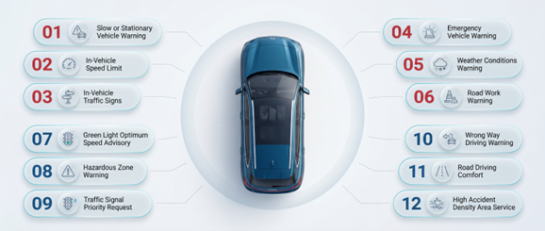
The C-ITS services to be tested on the C-ITS Test and Application Corridor are compatible with the service sets defined by the European Union C-Roads Platform and are being evaluated as part of a pilot implementation under real traffic conditions. The services tested on the corridor are presented in the figure below. During the technical visit the first 6 services which are marked in red will be shown.
The fiber optic communication infrastructure and network components installed along the corridor are configured to ensure high-capacity data transmission. Furthermore, 5G base stations have been deployed for the first time in the transportation sector in Türkiye, and system optimization work is ongoing. Thanks to the 5G communication infrastructure, data transmission will be provided with low latency and high bandwidth capacity.

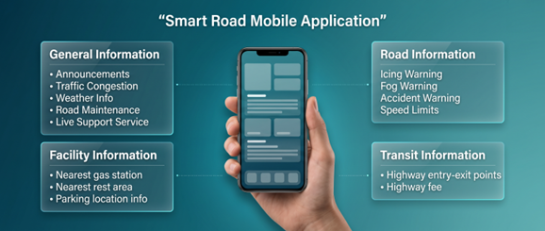
One of the most important projects being carried out simultaneously with the C-ITS Test and Application Corridor is the development of a Central Software Platform for Cooperative and Intelligent Transportation Systems. Developed using domestic resources, this central software platform aims to collect, monitor, and analyze data collected from all C-ITS and traditional ITS installed in the field under a single integrated structure. Following the completion of the central software platform, data obtained from the C-ITS Test and Application Corridor will be managed through this platform; in the future, a joint platform will be created that can be used by all Regional Directorates. With the mobile application to be implemented together with the central software, data collected regarding road conditions will be analyzed and transmitted to road users in real time.

The C-ITS Test and Application Corridor, as a pioneering application in Türkiye's transition to cooperative and connected transportation systems, offers a model that can be disseminated on a national scale. This corridor is more than just a technical pilot study implemented on a specific route; it forms the basis of a scalable and interoperable C-ITS architecture that will work integrated with the Central Software Platform. In this respect, the C-ITS Corridor serves as a technical, operational, and institutional reference for C-ITS applications planned to be established throughout Türkiye's entire road network in the future. Moreover, it presents a strategic model in Türkiye's transition to a connected and automated mobility ecosystem.
27 April Monday 14:00-15:30
14:00: Departure from ICC
14:30: Arrival at the corridor and showcasing of the corridor
15:00: Return to the ICC
15:30: Arrival back to the ICC
28 April Tuesday 10:00-11:30 & 14:00-15:30
10:00: Departure from ICC
10:30: Arrival at the corridor and showcasing of the corridor
11:00: Return to the ICC
11:30: Arrival back to the ICC
14:00: Departure from ICC
14:30: Arrival at the corridor and showcasing of the corridor
15:00: Return to the ICC
15:30: Arrival back to the ICC


